People do not achieve research success through random occurrences. The Softsasi Next Gen Research Methodology functions as a practical research workflow which guides researchers from their initial topic choice through their completed research paper while it decreases work duplication and increases chances of research paper acceptance. The system provides teams and academic groups with a standard process that includes collaborative writing, multiple assessment stages, research advisor support, and funding information access.
Why this methodology works
-
Clear stage gates reduce wasted effort and redundant drafts.
-
Collaborative drafting boosts output quality and speeds delivery.
-
Internal and advisor reviews catch problems early, lowering rejection risk.
-
Funding alignment and publisher selection are built into the flow, improving feasibility and timeliness.
-
Repeatable steps make it easy to train new members and scale research operations.
Core workflow (step by step)
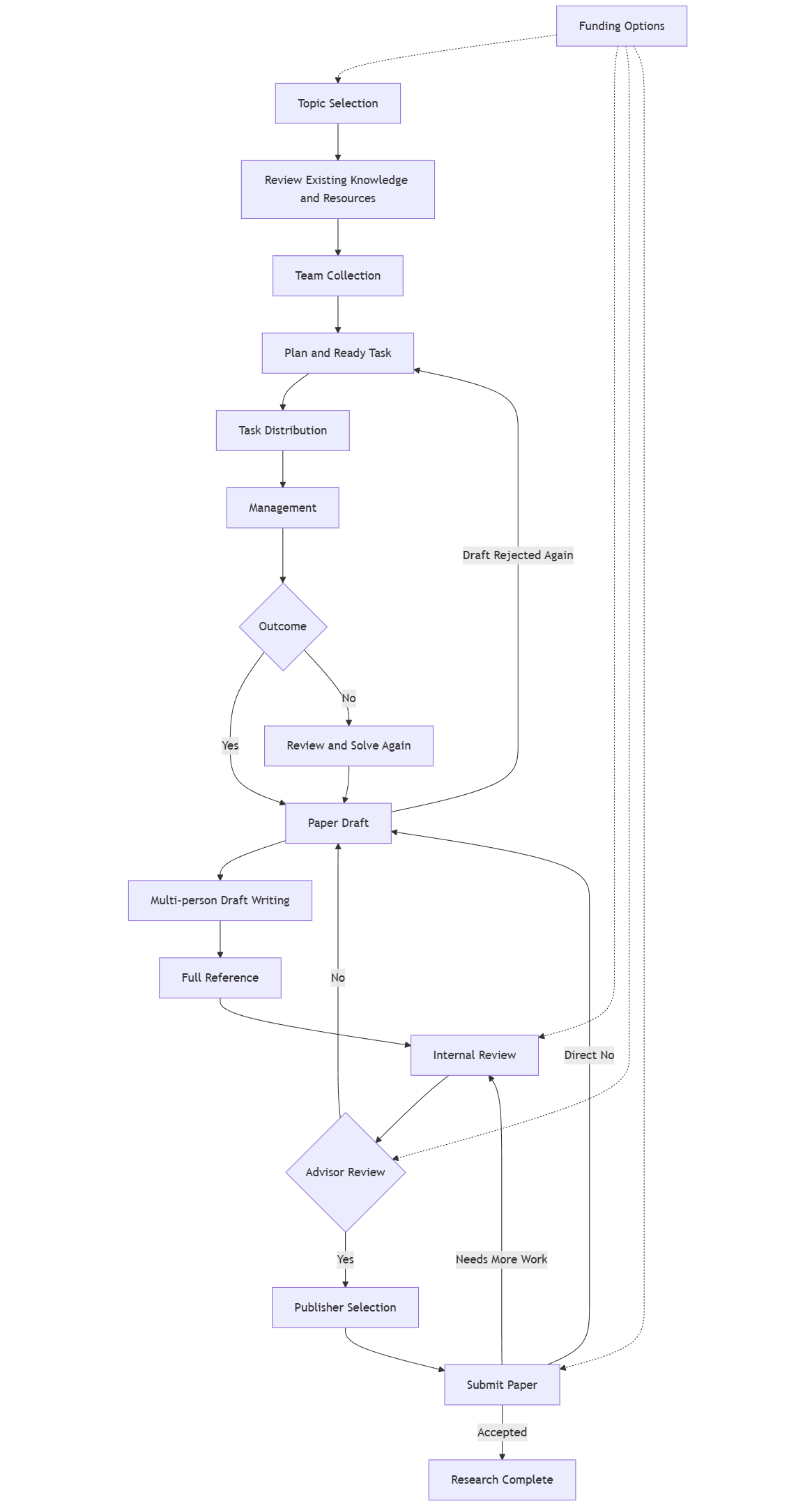
Below is the condensed, actionable workflow derived from the Softsasi flowchart. Use it as your team checklist.
-
Topic selection
-
Choose a problem with clear impact and feasible scope.
-
Check potential funding options early and align topic with funder interests if relevant.
-
-
Review existing knowledge and resources
-
Do a focused literature and tool scan.
-
Log datasets, code, prior art, and required compute or lab resources.
-
-
Team collection
-
Form a small cross-functional team with clear roles: lead researcher, data engineer, analyst, writer.
-
Record contact and contribution expectations.
-
-
Plan and ready task
-
Create a milestone plan with deliverables, owner, and deadlines.
-
Prepare a minimal reproducible baseline experiment or prototype.
-
-
Task distribution and management
-
Assign tasks and use an issue tracker or Kanban board.
-
Hold short standups or weekly syncs to remove blockers.
-
-
Outcome check and rapid iteration
-
Evaluate results against success criteria.
-
If results do not meet criteria, review and solve again, then re-run experiments.
-
-
Paper draft (multi-person draft writing)
-
Begin a collaborative draft early, with sections assigned to authors.
-
Keep a living reference list as you go.
-
-
Full references and reproducibility materials
-
Prepare full citations, dataset links, and code release plan.
-
Add a reproducibility appendix with environment, seeds, and commands.
-
-
Internal review
-
Run a structured internal review checklist before advisor review.
-
Fix language, completeness, figures, and baseline comparisons.
-
-
Advisor review
-
Submit the draft to the advisor. If the advisor requests changes, implement them.
-
If the advisor rejects or requests major changes, loop back to drafting and internal review.
-
Publisher selection
-
Choose journals or conferences that match scope and impact expectations.
-
Check formatting, page limits, and submission timelines.
-
Submit paper and follow up
-
Submit with required materials. Track submission status and be ready to respond to reviews.
-
If rejected, use reviewer comments to improve and resubmit or select a different venue.
-
Research complete
-
On acceptance, finalize camera ready copy, archive data and code, and promote results.
Funding options as a parallel track
The evaluation of funding alternatives needs to begin early in the process and require another assessment before submission. The funding determinations need to be made to establish project boundaries and data access rights and project schedule. The funding should serve as both a topic selection criterion and a backup plan for additional experiments which reviewers may require.
Essential templates and checklists
Use these to keep the process efficient.
- Internal review checklist
>The abstract provides a complete overview of the problem and the research method and the findings and the research contribution. >All figures legible and numbered. >The results of the experiment can be reproduced through the use of provided instructions. >The study conducted fair baseline comparisons which included proper citation of all used sources. >The references in the document are complete and follow the correct formatting standards.
-
Advisor submission email template
-
Short subject: Draft for review
-
Body: One paragraph summary, major contributions, what feedback you want, and desired timeline for reply.
-
-
Submission checklist
-
Manuscript formatted to venue template.
-
All required supplementary files attached.
-
Author list and affiliations correct.
-
Ethics approval or declarations included if needed.
-
Implementation tips for teams
-
Use collaborative tools: shared repo, Overleaf or Google Docs, issue tracker.
-
Lock a single source of truth for the manuscript to avoid multiple divergent copies.
-
Automate references with a shared BibTeX library.
-
Keep a short README in your repo with steps to reproduce key results in under 10 minutes.
-
Set weekly milestones with deliverable owners to avoid stalls.